
Mediation process: .nz Dispute Resolution Scheme
Mediation is a simple, quick, private and confidential way to resolve disputes. In this process, the parties work with a neutral, independent mediator to identify the issues, develop and explore settlement options, assess the implications of settlement options and negotiate an agreement that will work for everyone.
The aim is to empower parties to resolve conflicts quickly and affordably without having a decision imposed on them by an expert, arbitrator or judge.
If the parties do not agree to mediate or do not reach an agreement at mediation, the claimant can refer their claim to expert determination.

Process Overview
Start the process
Here is a step-by-step guide on how to initiate dispute resolution under the Domain Name Comission Dispute Resolution Scheme.
Submit the claim to Mediation
Complete and submit the mediation claim form.
NZDRC notifies the domain name holder
NZDRC forwards a valid claim to the domain name holder (respondent) within 5 working days.
Response
The respondent may respond within 10 working days by completing and submitting the mediation response form.
Appointment of the mediator
NZDRC appoints a mediator within 5 working days if the respondent agrees to mediation.
Mediation
The mediator fixes the timetable and conducts the mediation within 10 working days of the mediator’s appointment
Preparation
Good preparation by both the parties and the mediator is key to a successful mediation. Ensure you are set up for success before the mediation begins.
Opening Statements
An opening statement enables each party to express their perspectives and goals, setting the groundwork for negotiation. The claim and response forms are the basis of the opening statements.
Issue identification
In mediation, identifying issues is key to understanding the dispute and working toward a mutually acceptable resolution.
Joint sessions and 'caucusing'
Mediation typically involves joint sessions and separate sessions or ‘caucusing’.
Outcomes
Mediation outcomes range from full to partial settlements or no resolution. The process is beneficial in developing understanding, preserving relationships, and ensuring confidentiality.
Cost of mediation
As part of its public good focus, the Domain Name Commission pays for the mediator up to 10 working days and within the maximum hours allotted by NZDRC.
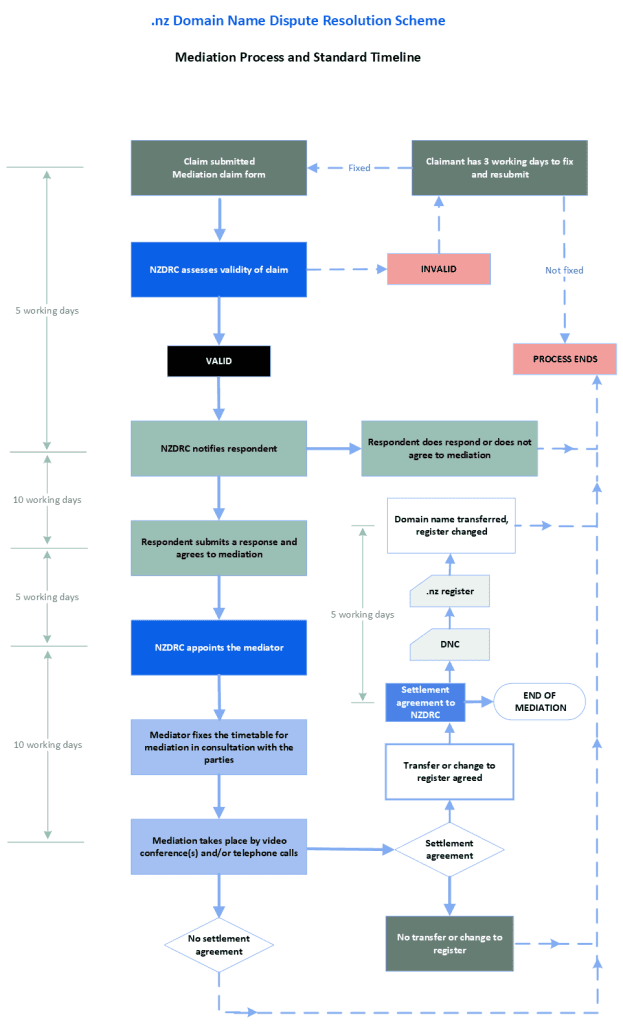
Mediation timeframe
Mediation is designed to enable the parties to resolve the dispute within 35 working days of the claim being submitted, and often less.
The time frame varies depending on the number and complexity of the issues and the parties’ willingness and availability to mediate.
The general timeline and maximum periods are:
- Claim submitted and reviewed by NZDRC: The claimant must submit the claim online to NZDRC. NZDRC will review the claim to make sure it is eligible under the scheme and that sufficient information has been provided.
- Invalid claim: If the claim is not eligible or is missing information NZDRC will advise the claimant. The claimant has three working days to fix the claim and provide any missing information. Otherwise NZDRC will reject the claim. (The claimant can re-submit the claim but must start the process again).
- Notification of valid claim to the respondent: NZDRC will send a valid claim to the respondent within five working days of it being submitted.
- Response: The respondent may submit a response to the claim online to NZDRC within 10 working days of receiving the claim.
- No response or no agreement to mediate: If the respondent does not respond or responds but does not agree to mediate, then the mediation process ends.
- Appointment of Mediator: If the respondent responds and agrees to mediate, NZDRC appoints a mediator within five working days of the response NZDRC provides the mediator with the claim, response and all documentation received from the parties.
- Mediation: The mediator fixes a timetable for mediation in consultation with the parties. Mediation must occur within 10 working days and the maximum number of hours allotted to the mediator.
- Outcome of mediation: If there is no settlement agreement, or the settlement agreement records that the parties agree that there will be no change to the .nz register, then the mediation process ends.
- Agreed transfer or change: If the settlement agreement records that the parties agree to a transfer of the domain name or a change to the .nz register, then the mediator must send the settlement agreement to NZDRC. NZDRC sends the settlement agreement via DNC to the .nz registrar to change the .nz register within 5 working days. When this is done, the parties are notified, and the process ends.
Mediation can be quicker if the parties are ready, available and prepared to mediate.
Step 1. Submit the claim to mediation
The claim must be submitted online using this form:
The form contains mandatory fields and requires information and documents as set out in the form. The ‘save and complete’ button allows you to save and return to the form later.
Contents of the claim form
A claim form that is missing any of the minimum information is invalid. However, the claimant can fix this by providing the correct information within three working days of receiving notice that the information is missing.
The claim must include the following information:
- Whether tikanga-based, other cultural, or accessibility support is requested
- If the claim is by a company, the company number, a copy of the certificate of incorporation or a screenshot of the Companies Register (or the overseas equivalents)
- Contact details of the claimant and any representative. A representative needs to sign a confidentiality agreement to be uploaded into the claim form. The confidentiality agreement can be found here
- The disputed domain name(s). We strongly recommend that the claimant orders a search of the .nz register to see if the respondent is holding other similar domain names that could be included in the claim: DNC Search Tool
- The nature and basis of the claim (see ‘what the claimant must establish in the claim’ below)
- Copies of any website screenshots, emails, correspondence, or other documents or evidence the claimant relies on and
- Submissions on the factual and legal issues involved in the claim. The onus is on the claimant to establish the grounds of the claim.
What the claimant must establish in the claim
The key grounds that the claimant must establish are (rule 1.5(a) or (b)):
- That it has Rights in a name or trademark that is identical or similar to the domain name, and
- That the domain name is an Unfair Registration – either at the time of registration or acquisition, or due to subsequent Unfair Use, and
- For a sub-domain dispute, the claimant must also show that the sub-domain added at the second level of .nz appears to be a third-level domain name per rule 1.5(b)(i).
In summary, the Claim should provide a clear explanation of the claimant’s rights in the same or similar name or trademark, why the domain name holder’s registration was unjust or its use of the domain name is unfair, and why the claimant should be the holder of the domain name, with supporting documentation.
Step 2. NZDRC notifies the domain name holder (respondent)
Within five working days after receiving a valid claim NZDRC will:
- Provide the claim to the current domain name holder or ‘registrant’ (the respondent).
- Instruct the Domain Name Commission to put a ‘compliance lock’ on the domain name under the .nz Rules until the dispute is determined or withdrawn.
- Invite the respondent to submit a mediation response form and agree to mediation. The respondent has 10 working days to respond.
If the respondent does not respond or agree to mediation, then mediation cannot occur, and the process ends. The claimant can refer their claim to expert determination.
Step 3. Response
A respondent may respond to the claim within 10 working days of receiving the claim.
The response must be made online using this form:
The response must include the following information:
- Whether tikanga-based, other cultural, or accessibility support is requested. See our tikanga framework document
- Contact details of the respondent and any representative. A representative needs to sign a confidentiality agreement to be uploaded into the response form
- In relation to the substance of the claim:
- what matters are accepted or agreed;
- what matters are disputed, and why;
- any defence to the claim (see ‘What the respondent must estabilish in the response’ below)
- Copies of any website screenshots, emails, correspondence, or other documents or evidence the respondent relies on and
- Submissions on the factual and legal issues involved in the claim, and any defences the respondent puts forward. While the onus is on the claimant to establish the grounds of the claim, once they do so then the onus is on the respondent to establish its defence. Guidance on this is set out below:
The response is an opportunity for the respondent to state its position regarding the claim and what is agreed and what is disputed. The respondent should set out what it says is the answer to the disputed matters and why they say their position is correct, with reference to supporting evidence and documents.
What the respondent must establish in the response
If the claimant establishes its key grounds (see Step 1) then the respondent needs to establish a defence, which may include:
- That the claimant does not have Rights in a name or trademark that is identical or similar to the domain name because they are Generic Terms or Descriptive Terms, and
- That the domain name is an Unfair Registration – either at the time of registration or acquisition, or due to subsequent Unfair Use and that the respondent’s use is fair, and
- For a sub-domain dispute, the claimant must also show that the sub-domain added at the second level of .nz appears to be a third-level domain name per rule 1.5(b)(i),
Step 4. Appointment of a Mediator
If the respondent submits a valid response and agrees to mediation, NZDRC will do its best to appoint a mediator within five working days.
NZDRC will select a mediator from its panel of qualified, independent mediators. The appointed mediator must remain neutral and cannot act as an advocate for any party or give legal advice.
NZDRC might ask the parties for more information to ensure the most appropriate appointment is made and there are no conflicts of interest. The parties should provide this information quickly to avoid unnecessary delays.
Any appointment made by NZDRC is final and can only be challenged based on a conflict of interest.
NZDRC will notify the parties of the appointment.
The mediator will consult with the parties and set a timetable for mediation.
Step 5. Mediation
The mediator fixes the timetable and conducts the mediation within 10 working days of the mediator’s appointment
The mediator meets with the parties (separately and/or together) to identify the issues, develop and explore settlement options, assess the implications of settlement options.
The mediator helps the parties negotiate an agreement that will work for everyone.
Step 6. Preparation
Before engaging in mediation, the mediator and the parties must be well-prepared.
The mediator may speak with the parties before any joint mediation session to introduce themselves, establish a structure for the mediation to follow, and answer any questions. The mediator’s preparation will also involve understanding the dispute, the parties involved, and the context in which the mediation has arisen.
Mediation is a negotiation, and it is useful to consider the other party’s needs and interests and to think about possible options for mutual gain or satisfaction. After all, mediation provides a forum for the parties to engage constructively and to problem-solve to resolve their dispute in a way that all parties are content with.
Step 7. Opening statements
Mediation usually involves the parties exchanging opening statements before the mediation.
In this process, the claim and response forms are intended to be the basis of the opening statements.
The parties can add to this in the mediation to outline their understanding of the dispute, the issues, their positions, and their interests. This sets the foundation for discussions during mediation.
The mediation provides a safe and structured space for each party to express their feelings and perspectives without interruption. This helps everyone involved to understand the situation from each other’s point of view, laying the foundation for a constructive dialogue and negotiation process.
Step 8. Issue identification
Identifying issues is a crucial step in mediation. The mediator helps the parties involved distinguish and understand the key points of conflict that need to be resolved. This is not about deciding who is right or wrong but rather about understanding what matters most to each party.
Mediation is a flexible process and may be conducted in many ways. However, in the early stages, the mediator is likely to guide a joint discussion where everyone openly discusses their concerns. This helps to bring the underlying issues to the surface. These could be misunderstandings, differences in expectations, or conflicting interests. Once these issues are identified, they can be addressed individually in the mediation process.
This step of issue identification can help clarify the dispute and can often reveal that parties have more common ground than they initially thought. This makes it easier to move forward towards finding a mutually acceptable resolution.
Step 9. Joint sessions and ‘caucusing’
Joint sessions and caucusing are two common stages.
In a joint session, all parties come together with the mediator to discuss the issues at hand. With the mediator’s help , they openly share their points of view, concerns, and what they hope to achieve. In a joint session, everyone is able to get a clear understanding of each other’s perspectives and the issues that need resolving.
In ‘caucusing’ the mediator meets privately with each party separately. These meetings are confidential and allow each party to discuss their concerns, thoughts, feelings and potential solutions with the mediator openly and without judgment.
The mediator can then use this information to help guide the parties toward an acceptable resolution. Without permission, the mediator will not share anything disclosed during the caucus with the other parties.
During a mediation, the parties may move in and out of joint sessions and caucusing as required to allow the mediation to proceed as effectively and efficiently as possible. The mediator will guide the parties on this.
Step 10. Outcomes
The parties may reach a full settlement where all issues are agreed upon. This ideal outcome leads to a formal ‘settlement agreement’ that is mutually satisfactory and binding for all parties involved. The agreement will be comprehensive, addressing all aspects of the dispute.
In other cases, a partial settlement may be achieved where some but not all issues are resolved. This is beneficial as it narrows down the areas of dispute and makes any further negotiations or legal proceedings more manageable. Often the agreements will be recorded in a ‘partial settlement agreement’.
If the full or partial settlement agreement includes the transfer of a domain name or any other change to the .nz register, the mediator will send it to NZDRC. NZDRC will send it via DNC and DNC will send it to the .nz registrar. DNC will direct the .nz registrar to transfer the domain name or change the register as per the parties’ agreement.
Under our standard settlement agreement template, the DNC is a party to the settlement agreement so that it can enforce that aspect of the parties’ agreement.
Sometimes, no settlement is reached, and the mediation ends.
While this might seem like a failure, the mediation process is beneficial. It provides a platform for parties to express their views and understand each other’s perspectives. This can lead to a clearer understanding of the dispute, which can be valuable in maintaining relationships and may facilitate future negotiations.
If the parties cannot resolve all issues, the claimant may submit the dispute to expert determination under the Scheme
Confidentiality is a fundamental aspect of mediation. Regardless of the outcome, subject to very limited exceptions, anything discussed during the mediation process is confidential and cannot be used in court or disclosed outside the mediation without consent.
This encourages open and honest communication, as parties can speak freely without fear that their words will be used against them later.
This confidentiality also extends to the mediator, who is not allowed to disclose any information about the mediation process or its outcome unless required by law or agreed upon by all parties.
Step 11. Cost of mediation
As part of its public good focus, the Domain Name Commission pays for the mediator up to 10 working days and within the maximum hours allotted by NZDRC: 4 hours over that period.
Unless agreed otherwise in a settlement agreement, the parties must pay their own mediation costs. This includes paying for their legal advice and any representative.
Next steps
Get in touch
Contact our team today to see how we can help